
Teacher CV Template: Sections, Skills, Example
Published Oct 28, 2026
A teacher CV template in the right order: qualification, classroom experience with subjects and levels, skills, and referees — plus a worked example.
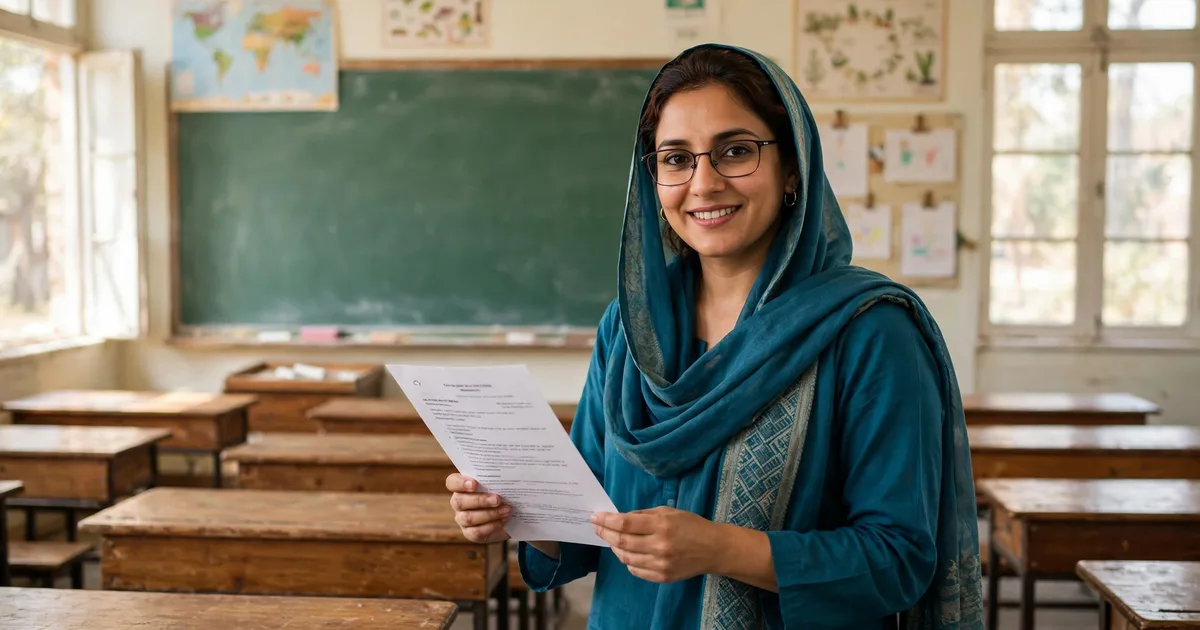
A teacher CV template is a ready-made order for your teaching story: name and contact details, a short summary, your teaching qualification, classroom experience with class sizes and results, subjects and levels you can teach, skills, education, and referees. Fill each part honestly, in that order.
A school does not read your CV the way a company does. The head teacher or the panel is asking three quick questions. Are you qualified to teach this subject? Have you actually stood in front of a class like ours? Can we trust you with our students? A good teacher CV answers all three in the first half page. This guide gives you the full template, what to write in each section, a worked example, and the mistakes that make schools in Pakistan and the Gulf put a CV aside.
The teacher CV template, section by section
Here is the order that works for almost every school job, from a small private school to a large academy chain.
1. Name and contact details. Your full name, the title "Teacher" with your subject (for example, "Mathematics Teacher"), your city, phone number, and a simple email address. If the ad asks for a photo, add a plain, formal one. If it does not ask, leave it out.
2. Professional summary. Three or four lines only: your qualification, your years of teaching, the levels you teach, and one strength. Example shape: "B.Ed-qualified science teacher with four years in middle school classes. Teaches grades 6 to 8, plans lessons from the national curriculum, and keeps parents informed with monthly progress notes."
3. Teaching qualification. Your B.Ed, M.Ed, ADE, or subject degree with teaching training, the institute, and the year. In Pakistan, schools look for this early. If you are still completing it, write the expected year honestly.
4. Teaching experience. Newest job first. For each school: your title, the school name and city, dates, the grades and subjects you taught, your class size, and what changed because of your work.
5. Subjects and levels. A short, plain list: subjects, grade levels, and boards or curricula you know (for example, national curriculum, Cambridge, IB). Schools hire for a timetable, so make this scannable.
6. Skills. Classroom skills in plain words: lesson planning, classroom management, checking understanding, remedial support, exam preparation, using a smart board or simple digital tools.
7. Education. Degrees newest first, with institute and year. Put your teaching qualification here too if you did not give it its own section higher up — but do not list it twice.
8. Certificates and training. Short courses, workshops, and training that help your teaching: assessment methods, inclusive education, first aid, child protection awareness.
9. Referees. Two names with phone numbers, or the honest line "Referees available on request" if the ad does not ask for them. A former head teacher or supervisor is the strongest referee for a school job.
What to write when you have little experience
New teachers worry about the experience section, but schools expect a thin section from a fresh graduate. Fill the space with true things that prove you can run a classroom:
Teaching practice from your B.Ed or training is real experience. Name the school, the grades you taught, and for how long. Private tuition counts when it is regular and you can describe it plainly: subjects, number of students, and how long you have done it. Volunteer teaching, summer camps, and coaching younger students also count. What you must not do is invent a school job. Panels ask simple questions about your last class, and an invented job falls apart in the first minute of the interview. If you are at this stage, our guide on how to write a CV that gets replies shows how to turn small, true experience into clear bullet points.
Writing experience bullets a school believes
Weak bullets list duties: "Responsible for teaching English to grade 5." Strong bullets show a class, a task, and a result:
- Taught English to two sections of grade 5, about 35 students each, using weekly reading and writing tasks.
- Prepared students for term exams; the class average in English rose across the year (keep the real figure if you know it, and only if you know it).
- Ran a remedial group of six weak readers after school, twice a week, for one term.
- Kept monthly progress records and shared them with parents at term meetings.
Notice what these bullets avoid: no claim you cannot prove, no borrowed numbers, no fancy words. A panel trusts plain proof. If you do not have a measured result, describe the work itself — the size of the class, the level, the task — because that is still evidence.
A worked example (invented, for shape only)
The names below are invented so you can copy the shape, never the facts.
Fatima Noor — Primary School Teacher, Lahore Phone and email. B.Ed, University of the Punjab, 2021.
Summary: Primary teacher with three years in grades 3 to 5. Plans lessons from the national curriculum, keeps a calm and active classroom, and writes short monthly progress notes for parents.
Experience: Primary Teacher, City Model School, Lahore, 2022–present. Teaches English and general science to grade 4, two sections of about 32 students. Prepares weekly lesson plans with the grade team. Runs a reading corner and a ten-minute daily reading start. Helps with the morning assembly rota and the annual sports day.
Before that: Teaching practice, Government Girls High School, 2021, eight weeks, grades 6 and 7 science.
Skills: lesson planning, classroom management, checking understanding, remedial reading support, basic smart-board use, parent communication.
Referees: available on request.
Applying in Pakistan versus the Gulf
The template stays the same, but the details a panel looks for change. In Pakistan, schools ask about your teaching qualification, your subject degree, and often your experience with the local board's exam pattern. Private schools in cities also value English fluency, so let your CV itself prove it: clean spelling and simple, correct sentences.
For Gulf schools, ads usually ask for a bachelor's degree in the subject, a teaching qualification, and a set number of years of experience — read the ad and mirror its words only where they are true for you. Many Gulf schools also recruit through portals that scan CVs by software first, so the plain one-column layout in our guide to an ATS-friendly CV is the safer shape there too: no photo boxes, no tables, no text in sidebars.
Mistakes that make schools stop reading
A photo page instead of a CV. A big photo, a border, and three lines of text tell the panel nothing.
No subjects or levels. "Teacher" alone forces the panel to guess your timetable fit. Always name subjects and grades.
Duties without classes. "Taught maths" says little. "Taught maths to grade 8, 40 students" says a lot.
Every school, every short job, no dates. Panels check dates. Missing dates read like something is being hidden, even when it is not.
Borrowed lines from the internet. Panels read hundreds of CVs; the copied summary lines are recognised at once, and they make the true parts of your CV doubtful too.
Spelling errors in a teacher's CV. Fair or not, a school judges a language teacher by the language on the page. Read it aloud once before you send it.
Build yours in the same shape
You can copy the order above into any editor and fill it in. If you want the structure held for you, the PakkiNaukri CV builder lays out these sections in a clean, single-column design that prints well and reads cleanly through school portals — pick the template, fill your real details, and download. Then check live school openings on the jobs board, and when a school calls you, prepare with our job interview checklist. A clear CV gets you the call; what you say in the room earns the job.
How long should a teacher CV be?
One page is enough for a new teacher and for most primary teachers. Two pages are normal once you have several years of service, more than one school, or extra duties like exam coordination or house leadership. Three pages are almost never needed, and length is not a sign of quality. Panels read fast: a tight two pages with dates, subjects, and class sizes beat four pages of duty lists. If your CV runs long, cut in this order: old short jobs that add nothing, repeated duties that are the same at every school, and general lines about yourself that any teacher could write. Keep the proof, drop the padding.
Primary, secondary, and subject teachers: what changes
The template order stays the same, but each level should stress different proof. A primary teacher should stress classroom care and range: the age group, all the subjects you handle, reading and number work, and how you keep parents informed. A secondary teacher should stress subject depth: your degree subject, the examination classes you have prepared, and your results where you honestly know them. A subject specialist, such as a computer science or art teacher, should add a short line about the lab, studio, or equipment you can run, and any student work you have supervised, like science fair projects or exhibitions.
If you teach more than one subject, list the main one first and name the second plainly. Schools build timetables from this page, and a clear "can teach" list — subject, grades, board — is often the line that gets your CV pulled out of the pile.
Three summary shapes you can adapt. A summary is four facts in one breath: qualification, years, levels, strength. Adapt these shapes with your own true facts, never with borrowed ones.
Shape one, experienced teacher: "[Qualification] teacher with [years] years in [level] classes. Teaches [subjects] to grades [range]. Known for [one true strength, such as calm classroom management or strong exam preparation]."
Shape two, new teacher: "Newly qualified [subject] teacher, [degree and institute]. Completed teaching practice at [school type] with grades [range]. Offers [one or two true skills, such as lesson planning and remedial support]."
Shape three, changing schools or cities: "[Subject] teacher with [years] years in [current setting], now applying in [city]. Brings [board or curriculum experience] and [one duty beyond the classroom]."
What to leave out. Leave out your full home address (city is enough), your national identity card number, your date of birth unless an official form asks for it, and family details such as your father's occupation — older local formats carried these, and government forms may still ask, but a school CV does not need them and they take space from your proof. Leave out salary history and reasons for leaving; those belong to the interview. Leave out hobbies unless they add to school life — coaching a sport, running a drama club, or leading a scout group genuinely helps a school application, so name those and skip the rest.
Before you send: a five-minute check. Print the CV or open the PDF at full size. Check that your phone number is the one you actually answer, that dates line up with no unexplained overlap, that every school name is spelled the way the school spells it, and that the file name carries your name and the word CV, such as Ayesha-Khan-Teacher-CV.pdf. Send the format the ad asks for; when the ad names nothing, a text-based PDF is the safe default. Finally, keep one master copy with everything, and make a shorter copy per application that moves the most relevant teaching to the top. Tailoring means reordering your true facts for the reader — never adding facts that are not yours.
Questions the panel will ask — your CV should answer them first
A good teacher CV quietly answers the questions the panel is already holding. How many students were in your classes? Your bullets should say. Which board's papers have your students sat? Name it. Have you ever handled a weak class, a mixed-ability class, or examination pressure at the end of term? One honest bullet about remedial work or exam preparation answers it. Have you done anything beyond your own classroom — assembly duty, sports, a club, parent meetings? Schools run on these extras, and one line about them shows you understand school life, not just lessons.
Read your finished CV with those questions in mind. Where the answer is missing and the fact is true, add the fact in the right section. Where a claim has no fact behind it, take the claim out and let the real record speak. That single habit — every line backed by something a referee could confirm — is what separates the CVs panels trust from the ones they set aside.
If you are applying through a portal or by email. Many school groups and Gulf recruiters now collect CVs through online forms that store and search them by software before a person reads them. For those applications, keep the same content but the plainest possible shape: one column, standard headings such as Experience and Education, no tables, no text inside pictures, and your contact details typed in the body of the page, not in a header strip. Name the file with your name and subject. When you apply by email instead, keep the message short: the post you are applying for, your qualification and years in one line, and the CV attached. The email is a cover note, not a second CV.
References and character proof in school hiring. Schools hire a person who will be alone with children, so character proof weighs more here than in most fields. Choose referees who have actually seen you teach or work with young people: a head teacher from your teaching practice, a principal from a previous school, a supervisor from tuition or volunteer work. Tell each referee you have applied and where, so a call does not catch them unprepared. If a post is with a government school or a large chain, expect the documents behind your CV to be checked — degrees, teaching qualification, identity — and keep clean copies ready; a strong CV followed by missing documents stalls at the last step. Finally, remember that panels talk to each other within a city more than applicants realise. The teacher whose CV, documents, and interview all tell the same true story builds a name that travels ahead of the next application.
School hiring has a season — use it. In Pakistan, most school hiring moves before the new academic session and again at the winter break, when panels plan next term's timetable. A CV prepared in the quiet weeks — documents copied, referees informed, template tailored for the two or three school types you target — reaches those panels while they are still building their lists, instead of after the timetable is set. Keep your master copy current through the year, and let each season's applications be quick, tailored copies of a page that was ready before the rush.
Applications sent in the season's first weeks, from a CV that was ready before the rush, are the quiet advantage well-prepared teachers carry into every hiring round.
Frequently asked questions
What should a teacher CV include?
Your name and subject, a short summary, your teaching qualification, classroom experience with grades, subjects and class sizes, a subjects-and-levels list, classroom skills, education, certificates, and referees. Put qualification and experience early, because panels check those first.
How long should a teacher CV be?
One page for a new teacher, two pages once you have several years and more than one school. Length is not quality: panels prefer a tight page of dated, provable teaching over a long list of duties.
I am a new teacher with no school job yet. What goes in experience?
Teaching practice from your training, regular tuition you can describe, volunteer teaching, camps, and coaching. Name the school or setting, the grades, and the period for each. Never invent a school job; panels test it in the first interview question.
Should I add a photo to my teacher CV?
Only if the advertisement asks for one; then use a plain, formal photo. If the ad does not ask, leave it out and give the space to your subjects, levels, and results.
Does this template guarantee a teaching job?
No template can guarantee a job or an interview. This order simply makes your real qualification and classroom record easy for a panel to check, which is what a CV can honestly do.
Put it to work on real, checked jobs.
Every job on PakkiNaukri is taken from a company’s own careers page and re-checked daily, and a free account scores each one against your CV. Start with today’s list.